

TL;DR:
- Effective AI adoption depends on strong governance, data, talent, and strategic focus.
- Regulated industries face unique risks like model degradation and hallucinations impacting compliance.
- Leadership should diagnose gaps, align on outcomes, and build cross-functional teams before scaling AI.
Most boardrooms treat AI adoption as a technology procurement decision. Buy the right platform, hire a few data scientists, and transformation follows. That assumption is expensive. Enterprise AI failures trace back to poor governance, weak data foundations, and workforce gaps far more often than to the wrong algorithm. C-suite leaders in regulated industries face a compounding challenge: the stakes of getting AI wrong are higher, the compliance requirements are stricter, and the window for competitive advantage is narrowing. This guide reframes AI adoption around the decisions that actually determine outcomes: data strategy, people readiness, and deliberate strategic bets.
Table of Contents
- What AI really means for the C-suite
- Critical success factors for AI integration
- AI risks, edge cases, and compliance in regulated industries
- How to begin: Practical strategies for C-suite adoption
- What most C-suite advice on AI misses
- Unlock AI value for your business
- Frequently asked questions
Key Takeaways
| Point | Details |
|---|---|
| Success depends on people | AI delivers business value only with strong leadership, workforce readiness, and cultural alignment. |
| Governance reduces failure | Clear accountability and investment strategies minimize risk of AI adoption in regulated sectors. |
| Compliance requires smarter models | Physics-informed and neuro-symbolic AI boost auditability for high-stakes decisions. |
| Strategic bets beat table stakes | Focusing resources on transformative AI delivers more competitive advantage than following trends. |
What AI really means for the C-suite
AI is not a single technology. It is a portfolio of capabilities ranging from predictive analytics and natural language processing to computer vision and autonomous decision-making agents. For executives, the relevant question is not "what can AI do?" but "which AI capabilities create durable business value in our specific context?"
The distinction matters because most AI conversations at the leadership level collapse into vendor pitches and proof-of-concept theater. Real transformation requires clarity on three core levers:
- Data: The quality, accessibility, and governance of your organization's data determines what AI can actually do. Poor data produces unreliable outputs regardless of model sophistication.
- Talent: AI projects fail when technical teams operate in isolation from business units. Cross-functional ownership is not optional.
- Strategic focus: Deploying AI across too many initiatives dilutes impact. Workforce readiness and strategic bets improve AI success rates by 18% compared to organizations spreading resources thin across table-stakes applications.
A common CEO misconception is that AI is primarily an IT initiative. It is not. AI reshapes how decisions get made, how risk is priced, and how value is created at scale. In regulated industries, it also changes what you are legally accountable for.
"The organizations winning with AI are not necessarily those with the most advanced models. They are the ones with the clearest strategic intent and the strongest data and talent foundations."
Consider how Gestoos applied AI to solve a concrete business problem with measurable outcomes. That is the executive framing worth adopting: AI as a lever for specific, accountable business results, not a general-purpose transformation engine.
Pro Tip: Before approving any AI investment, require the business sponsor to articulate the specific decision or process the AI will improve, the data required to support it, and the metric that will confirm success.
Critical success factors for AI integration
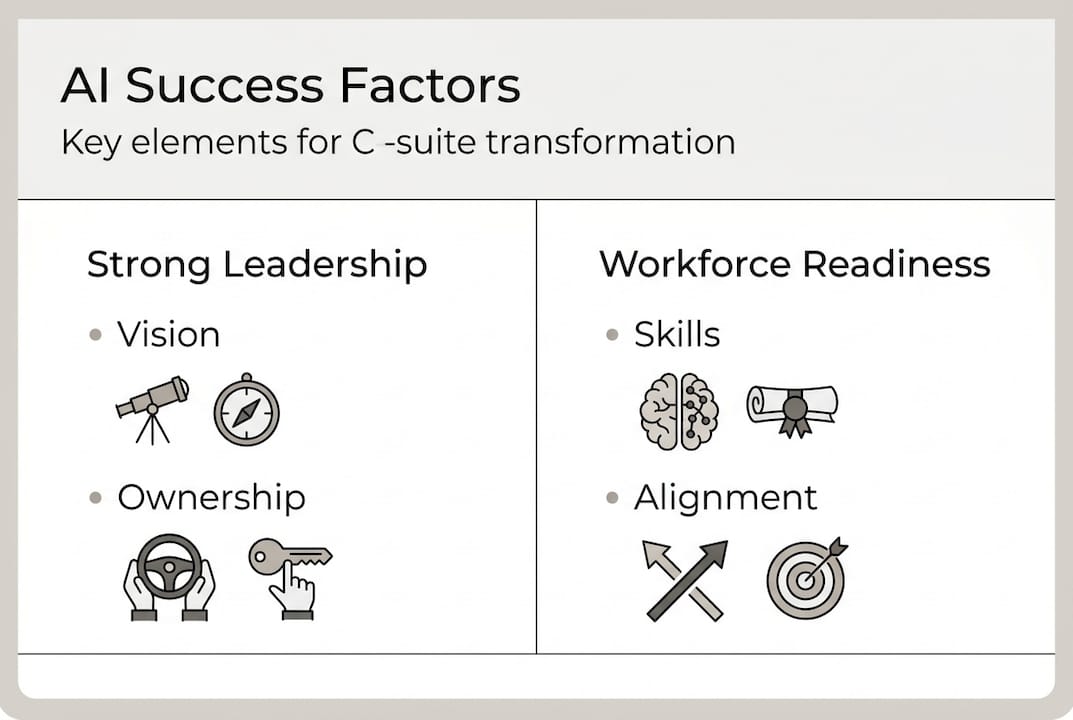
Setting the right foundations separates organizations that extract sustained value from AI and those that accumulate expensive pilots. Four factors consistently determine which side of that line a company lands on.
- Governance structures: AI governance is not a compliance checkbox. It is the mechanism by which accountability is assigned, decisions are audited, and risks are managed. Poor governance and lagging investment are the primary drivers of enterprise AI failure. Effective governance includes clear ownership at the executive level, defined escalation paths, and regular review cycles tied to business outcomes.
- Workforce readiness: Your employees need to understand AI well enough to use it effectively and flag it when it is wrong. That requires structured upskilling, not just access to tools. Explore workforce upskilling resources to understand what effective programs look like in practice.
- Data infrastructure: AI models are only as reliable as the data pipelines feeding them. Before scaling any AI initiative, audit data quality, resolve ownership ambiguities, and establish access controls that satisfy both operational and regulatory requirements.
- Strategic alignment: AI investments tied to specific strategic priorities outperform those justified by competitive pressure alone. Define where AI creates asymmetric advantage for your organization, and concentrate resources there.
| Factor | High-maturity organizations | Low-maturity organizations |
|---|---|---|
| Governance | Executive ownership, defined accountability | Fragmented, project-level only |
| Workforce | Structured upskilling programs | Ad hoc tool access |
| Data | Centralized, auditable pipelines | Siloed, inconsistent quality |
| Strategy | Focused bets on priority use cases | Broad, undifferentiated pilots |
Pro Tip: Run a rapid diagnostic across these four factors before committing capital to any AI initiative. Gaps in governance or data infrastructure will undermine even well-designed models. Engaging AI leadership expertise early reduces costly course corrections later.
AI risks, edge cases, and compliance in regulated industries
Regulated industries carry a specific burden: AI errors have consequences that extend beyond business performance into legal liability, patient safety, and systemic financial risk. Understanding the technical failure modes at the board level is not optional.
Model degradation occurs when an AI system's performance declines over time as real-world data drifts away from the patterns the model was trained on. In financial services, this can mean credit risk models that quietly become less accurate as economic conditions shift. In healthcare, it can affect diagnostic support tools. Without continuous monitoring, degradation goes undetected until outcomes deteriorate.

Hallucinations are a specific failure mode of large language models, where the system generates confident but factually incorrect outputs. In high-stakes workflows such as contract review, regulatory reporting, or clinical documentation, model hallucinations and degradation create material risk that boards must account for.
The compliance implications vary by sector:
- Financial services: Models influencing credit decisions, fraud detection, or trading must be explainable and auditable under existing regulatory frameworks.
- Healthcare: AI supporting clinical decisions requires validation against clinical standards and clear human oversight protocols.
- Automotive: In-cabin AI systems must meet functional safety standards. See how automotive in-cabin AI addresses these requirements in practice.
For regulated environments, neuro-symbolic models and physics-informed approaches offer a meaningful advantage over pure deep learning. They produce outputs that can be traced back to interpretable logic, which satisfies auditability requirements and supports regulatory defense.
Key metric: Organizations that implement continuous model monitoring reduce compliance incidents related to AI outputs by a significant margin compared to those relying on periodic review cycles alone.
How to begin: Practical strategies for C-suite adoption
Knowing the risks and success factors is useful. Acting on them requires a structured approach that fits how executive teams actually make decisions.
- Diagnose before you invest. Map your current data assets, governance structures, and workforce capabilities against the four success factors outlined above. Identify the largest gaps and prioritize closing them before scaling AI deployments.
- Build cross-functional teams. The most effective AI projects are led by business owners with technical support, not the reverse. Pair domain experts who understand the regulatory context with AI practitioners who can translate requirements into model design.
- Define measurable outcomes. Every AI initiative should have a defined business metric, a baseline, and a timeline for demonstrating impact. Vague transformation goals produce vague results.
- Establish governance before scaling. Pilot programs can operate with lighter oversight. Scaled deployments cannot. Build the governance infrastructure, including monitoring, escalation, and audit trails, before moving from pilot to production.
- Invest in agentic AI capabilities where transformation is the goal. Agentic AI, systems that can plan and execute multi-step tasks autonomously, represents the frontier of enterprise value creation. It also requires the strongest governance and workforce readiness.
Pro Tip: Assign a senior executive as AI sponsor for each major initiative. Not a technical lead. A business leader who is accountable for the outcome and has the authority to remove organizational obstacles.
Key pitfalls to avoid:
- Treating AI governance as a one-time setup rather than an ongoing operational function
- Underestimating the time required to prepare data infrastructure before model deployment
- Measuring AI success by adoption rates rather than business outcomes
- Allowing vendor roadmaps to substitute for internal AI strategy leadership
What most C-suite advice on AI misses
Most AI guidance for executives focuses on technology selection and ROI frameworks. That is the wrong starting point. The organizations that consistently succeed with AI are not the ones with the most sophisticated models. They are the ones that invested in culture and talent before they invested in algorithms.
Workforce readiness is routinely underestimated because it is harder to budget and slower to show results than a software deployment. But ignoring it creates a specific failure pattern: capable AI systems that employees distrust, misuse, or work around. The technology functions; the transformation does not.
Boardroom narratives also tend to downplay governance because it feels like overhead. In regulated industries, that instinct is particularly dangerous. Governance is not a constraint on AI value creation. It is the mechanism that makes sustained value creation possible.
Real innovation in AI comes from strategic bets, not incremental pilots. Explore practical AI leadership lessons to understand what distinguishes organizations that move from experimentation to competitive advantage. The difference is almost always leadership clarity and organizational commitment, not technology.
Unlock AI value for your business
The frameworks in this article reflect the realities that executive teams encounter when moving AI from strategy to execution. Seeing them applied in practice accelerates the learning curve significantly.

Review the Gestoos AI transformation case study to see how a focused AI strategy produced measurable business outcomes in a complex environment. For organizations navigating regulated industry challenges, Germán León's AI strategy and advisory services provide the expertise to move from diagnosis to execution with confidence. Whether you need a keynote to align your leadership team or a structured advisory engagement, the path forward is clearer with an experienced partner.
Frequently asked questions
What is the biggest risk of AI in regulated industries?
Model degradation and hallucinations are the most critical risks because they can influence high-stakes decisions without obvious warning signs, making continuous monitoring and auditability essential for compliance.
How can C-suite leaders ensure AI projects succeed?
Projects with strong data foundations and workforce readiness improve AI success rates by 18%, so leadership alignment on both factors before deployment is the most reliable predictor of positive outcomes.
What types of AI should C-suites prioritize?
Agentic AI delivers the highest transformation potential, while physics-informed and neuro-symbolic models are the strongest choice for regulated environments where auditability and explainability are required.
Is workforce upskilling really necessary for AI transformation?
Yes. Workforce readiness is a core success factor because employees who cannot evaluate AI outputs effectively create failure points that technology alone cannot resolve.